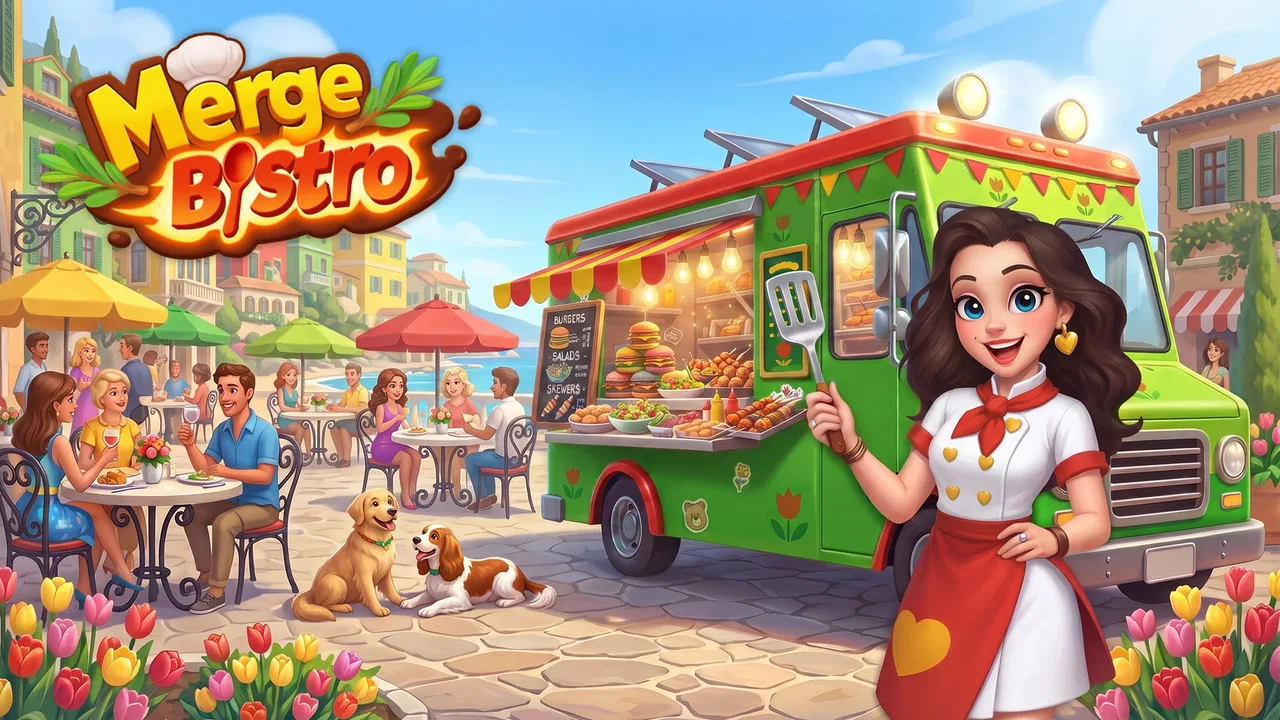
Merge Bistro™ Cook & Decor
- 4.8
- Rating
- 1.00M
- Installs
- Free
- Price

 Analysis by App-foxy
I spent time with Merge Bistro™ Cook & Decor as a casual puzzle game, and its appeal became clear quite quickly: it turns combining objects into a gentle routine built around a small restaurant and a developing romance. That combination gives the familiar merge format a warmer purpose than simply clearing a board. You are not only matching pieces; you are gradually helping a bistro take shape while uncovering more of its story.
That makes it an easy game to recommend to someone who wants short, low-pressure sessions rather than a demanding competitive challenge. I could imagine opening it during a quiet coffee break, making a few combinations, checking the next task, and putting it away without feeling that I had abandoned a complicated strategy plan. At the same time, the relaxed presentation should not be mistaken for unlimited freedom. The way you spend space, follow objectives, and decide which items to merge matters more than the calm atmosphere initially suggests.
How the bistro puzzle loop feels in everyday play
The central idea is simple: merge matching items, use the results to complete cooking-related goals, and spend the rewards on the bistro’s development and decoration. The loop is approachable enough for someone who rarely plays puzzle games, but it still offers small decisions that make each session feel active. Instead of asking you to solve one isolated level and move on, the game gives your actions a continuing place in the restaurant and its story.
You May Also Like

 Blood Strike: 2.5 Anniversary
Blood Strike’s Loadouts Turn Every Drop Into a Tactical Gamble
A close look at Blood Strike’s custom loadouts: how fast access to signature weapons reshapes its battle royale rhythm, rewards preparation, and narrows the gap between fights.

 Pandora - Music & Podcasts
Pandora’s Music Is Easy to Start, but Harder to Recover
Pandora’s strength is its low-effort path from a seed to a station. Its weak spot is how much confidence it asks you to place in connection, setup, and quiet recovery.

 8 Ball Pool
 Is Built on Rivalries, Rematches, and Routine
A close look at the rivalries, rematches, shared routines, and unanswered safety questions that turn a quick pool match into a persistent mobile community.

 Samsung Music
’s Quiet Strength Is Playing What You Already Own
Its reach comes less from spectacle than from dependable access to a personal library. That simplicity is both the app’s strongest retention engine and its ceiling.

 AccuWeather: Weather Radar
AccuWeather Review: A Quick, Clear Forecast for Everyday Decisions
For everyday plans, the best forecast is the one you can understand quickly. AccuWeather makes rain timing, radar, and local conditions easy to act on, with a few trade-offs.

 Hill Climb Racing
Why Hill Climb Racing Still Turns Crashes Into One More Run
A tiny car, a bumpy hill and one more upgrade: Hill Climb Racing keeps resurfacing because its simple chaos makes every near-miss feel personal.
More From Our News Desk



I especially liked the way the cooking theme gives context to the usual chain of upgrades. In a more abstract merge game, a new object can feel like a random step in a production line. Here, the restaurant setting makes progress easier to understand. You are working toward a meal, an improvement, or a new piece of the bistro rather than merging simply because the board tells you to.
The romantic storyline also changes the pace. It creates a reason to care about what happens between tasks, even when the puzzle itself is fairly quiet. Players who enjoy light narrative alongside decoration will probably find this more inviting than a purely mechanical merge board. If you prefer fast action, complex deduction, or a story with a serious dramatic tone, the gentle approach may feel too soft.
One useful habit is to look at the current objective before filling the board with easy combinations. It is tempting to merge whatever is immediately available, especially when the early moves feel effortless. I found that pausing to identify the requested item helped me avoid creating a crowded collection of intermediate pieces that did not serve the next goal. This is one of the game’s less obvious trade-offs: quick merges feel satisfying, but purposeful merges usually make the session cleaner.
The bistro setting is also useful when deciding whether to keep playing. If I wanted a few minutes of progress, I could focus on a nearby task rather than treating the whole story as one long commitment. That makes the game suitable for waiting rooms, short commutes, or a winding-down routine. It is less suitable if you want a puzzle that ends decisively after each round, because the restaurant and narrative progression encourage you to return later.
What happens when the board becomes busy
Merge games often feel fastest at the beginning of a session, when the board has room and the next combinations are obvious. The same principle applies here from a player’s perspective: a tidy board makes decisions quick, while a crowded one makes every move feel slower because you must inspect more objects and plan around limited space. The challenge is not only producing the requested item; it is preserving enough room to continue producing it.
My practical advice is to avoid treating every available merge as equally valuable. Keep an eye on the chains that are connected to the current cooking request, and resist spending space on unrelated lines unless they are helping clear the board. This approach is more important during longer sessions, when a series of small decisions can leave the play area awkwardly packed. The game feels more relaxing when you create room deliberately instead of waiting until the board becomes difficult to read.
That is also where the title’s decoration side can influence your priorities. It is satisfying to improve the bistro, but decorative progress should not distract from the basic rhythm of producing useful items. I found the best flow came from treating the restaurant upgrades as a reward for organized puzzle play, not as a reason to make random merges.
For heavy use, I would set expectations sensibly. This is a touch-based puzzle game, not a graphically intense action title, so its main pressure comes from repeated interaction and prolonged attention rather than rapid reflexes. A long session can become mentally repetitive if you are not invested in the cooking theme or the romance. Shorter visits make the merge loop feel more pleasant and keep the decoration and story elements from becoming background noise.
A realistic everyday scenario would be using it after dinner when I want something more engaging than scrolling but less demanding than a competitive game. I could complete a few cooking objectives, make one or two thoughtful space-saving decisions, and stop after a small story beat. In that situation, the game works well because it does not require me to remember a complicated control scheme or maintain constant concentration.
Speed, stability, and the cost of convenience
From a user’s point of view, the game is built for a measured pace. The merge actions themselves are easy to understand, and the broader progression gives each visit a clear purpose. I would not choose it when I want instant, high-energy entertainment, but I would choose it when I want a puzzle that lets me think without rushing.
The free entry point makes it easy to try without committing money first. That matters for this type of game because the appeal depends heavily on whether you enjoy the particular blend of merging, cooking, decoration, and story. There are in-app purchases ranging from less than a dollar to amounts reaching ninety-nine dollars and ninety-nine cents per item, so I would approach optional spending carefully. The sensible test is to play naturally first and decide whether the basic loop is enjoyable without treating purchases as part of the expected cost of entry.
That spending range also affects how I would recommend it to families. The content rating is Everyone, which makes the theme broadly accessible, but adults should still be aware that free-to-play progression can invite optional purchases. The game is a better fit for a child or younger player when purchase controls and expectations are discussed in advance. The age rating describes the content, not how each person will respond to spending prompts.
In normal puzzle use, the important performance question is not whether the game delivers console-like spectacle. It is whether the board remains comfortable to manage, whether transitions feel dependable, and whether progress remains understandable when you return after a break. I found the design’s strongest performance advantage to be its modest, focused scope: the restaurant, merge board, and story all support the same core activity rather than competing for attention.
Heavy use can still expose ordinary friction. A crowded board demands more taps and more visual checking, and a player who keeps every intermediate item may spend more time organizing than solving. That is not a technical failure, but it can feel like a slowdown. The best way around it is to make space management part of the puzzle instead of postponing it until the end of a session.
Recovery is another reason to play with a little discipline. Before leaving, I would finish the smallest practical objective, note what the next task needs, and avoid making a chain of uncertain moves just before closing the game. That habit makes it easier to resume later because the board has a clear purpose. It also reduces the chance of returning to a cluttered layout and forgetting why several items were being kept.
Device fit and who should think twice
The game supports devices running Android 7.0 or later, so it is not restricted to only the newest Android hardware. That broad compatibility is useful for players who keep an older phone as a secondary device or who do not upgrade frequently. Still, compatibility alone does not guarantee that every device will feel identical. Screen size, touch responsiveness, available storage, and general device condition can all affect how comfortable a merge board feels.
On a smaller screen, careful organization becomes more important because several item groups may compete for attention. A larger display should make it easier to scan the board and distinguish related objects, especially during a longer session. I would also keep the device in a healthy state before blaming the game for sluggishness: closing unusually demanding background activity and keeping reasonable free space are sensible steps for any mobile title.
The game’s demands are likely to feel most manageable for people who want a calm, mostly stationary experience. It is not the right choice for someone looking for a game that rewards rapid swipes, precise timing, or constant visual action. It may also disappoint players who expect restaurant management with detailed business systems, because the emphasis here is on merging and story-led decoration rather than running a realistic kitchen.
Players who dislike waiting, gradual progression, or optional purchase pressure should be cautious. Even when the puzzle decisions are enjoyable, the overall structure is designed to bring you back repeatedly rather than provide one complete experience in a single sitting. By contrast, fans of cozy mobile games, light romance, and collection-based puzzle routines will find the design more naturally suited to their habits.
Compared with a traditional match-three game, this feels less like a sequence of self-contained boards and more like a continuing project. A match-three alternative is usually better when I want quick rounds, immediate scoring, and a clear reset after every attempt. This game is better when I want my puzzle actions to feed into a restaurant makeover and a continuing narrative.
Compared with a pure decoration game, the merge board gives me more to do between visual changes. The trade-off is that decorating is not the entire experience, so someone who mainly wants to arrange rooms and furniture may prefer a dedicated design title. Compared with a more complex cooking simulator, this is much easier to pick up, but it does not aim to reproduce the pressure or detail of an actual kitchen.
What makes the experience worth returning to
The strongest reason to return is the relationship between small puzzle decisions and visible personal progress. I am not simply chasing a score that disappears when the round ends. The bistro provides a sense of place, while the love story gives the next task a little emotional context. That combination is modest, but it helps the routine feel more meaningful than an endless chain of identical merges.
A second strength is that the game can accommodate different session lengths. I can make a few efficient moves when I have limited time, or spend longer organizing the board when I want a more involved break. The key is not to confuse flexibility with unlimited depth. After the novelty of the setting settles, the enjoyment depends on whether the repeated merge-and-reward rhythm continues to suit you.
A third insight is that the game rewards restraint more than speed. New players may assume the best move is always the largest immediate merge. In practice, preserving useful chains and open space can be more valuable than clearing one attractive combination. That makes the experience quietly strategic, even though the presentation remains friendly and relaxing.
I also appreciate that the cooking theme gives players a natural way to set personal goals. One visit can focus on completing the next recipe-related request; another can focus on cleaning up the board; a third can simply advance the story. Those self-chosen priorities help prevent the game from feeling like a single repetitive task, particularly for players who enjoy gentle routines.
The main limitation is that the same relaxed structure will not satisfy everyone. If the story does not interest you, the decoration may not be enough to carry the repeated merging. If you want a puzzle with increasingly demanding logic, the cozy presentation may feel shallow. And if you are sensitive to optional spending in free games, you will need to maintain a firm boundary and judge the experience on its no-purchase appeal.
My overall recommendation
Gaming Laboratory has made a puzzle game that understands the value of atmosphere. The restaurant, cooking goals, decoration, and romance work together to make merging feel like part of a small ongoing world. The result is approachable, easy to fit into ordinary breaks, and more personable than a bare matching board.
The game has attracted over one million installs and holds a 4.8 average from around twelve thousand ratings, which matches my impression that its cozy formula has broad appeal. It has also received around three hundred written reviews, giving prospective players more evidence that the concept connects with a substantial audience without changing the fact that personal taste matters most here.
The current version is 2.1.4, and the game is free to start. I would recommend installing it if you enjoy relaxing merge puzzles, light narrative, and gradually improving a welcoming restaurant setting. I would skip it in favor of a traditional match-three game if you need short, sharply defined rounds, or choose a deeper simulation if detailed cooking management is the main attraction.
For me, the final verdict is positive with a clear condition: play it as a calm, repeat-visit puzzle journey, not as a fast action game or a full restaurant simulator. Organize the board before it becomes crowded, follow objectives instead of merging blindly, and treat purchases as optional rather than necessary. With those expectations, Merge Bistro™ Cook & Decor is an inviting choice for quiet sessions and a pleasant way to turn a familiar puzzle formula into a small story about food, place, and connection.
FAQs for Merge Bistro™ Cook & Decor
01What is Merge Bistro™ Cook & Decor?
Merge Bistro™ Cook & Decor is a casual merge game that combines restaurant management, cooking, and decoration. You merge matching ingredients and useful objects to create new items, complete customer orders, and progress through the bistro’s story. Along the way, you can renovate and personalize different areas, making it suitable for players who enjoy relaxed puzzle gameplay with a light simulation and design element.
02How does the gameplay work in Merge Bistro™ Cook & Decor?
The main gameplay revolves around merging identical items on a board to produce upgraded ingredients, kitchen tools, and other useful objects. These items are then used to fulfill tasks and recipes, earn rewards, and unlock additional content. Energy or similar limits may restrict how quickly you can perform actions, so progress involves planning merges carefully rather than combining everything immediately.
03Can Merge Bistro™ Cook & Decor be played offline?
Some basic gameplay may remain available without a constant internet connection, but offline access can be limited depending on the version and device. Features such as advertisements, cloud synchronization, events, purchases, or certain updates may require an internet connection. For the most reliable experience, it is best to launch the game online and check its current store description before downloading.
04Does Merge Bistro™ Cook & Decor include in-app purchases or advertisements?
Merge Bistro™ Cook & Decor is free to download, but players should expect optional in-app purchases and advertising as part of its progression system. Purchases may provide currency, energy, boosters, or other advantages, while ads can sometimes offer bonus rewards. The game can generally be enjoyed without spending money, although patience may be needed when energy or resources run low.
05Is Merge Bistro™ Cook & Decor suitable for children and casual players?
The game is designed for casual audiences and uses simple merge mechanics, colorful visuals, and an approachable restaurant theme. However, parents should review the age rating, advertising content, and purchase settings on the relevant app store before allowing children to play. Because progress can involve waiting, rewards, and optional purchases, parental controls are recommended for younger users.
Pros
- Relaxing merge gameplay is easy to learn and suitable for short sessions.
- Restaurant renovation gives progress a clear visual purpose.
- The cooking theme adds variety beyond standard merge puzzles.
- Decor choices let players personalize the bistro’s appearance.
- Playable offline in many situations
- making it convenient while traveling.
Cons
- Energy limits can interrupt play when you want longer sessions.
- Some upgrades and areas require substantial resource grinding.
- Random item drops may make specific merge chains frustrating.
- Frequent events can make progression feel pressured or repetitive.
- The game may use significant storage and battery during extended play.

Merge Bistro™ Cook & Decor
Gallery